Particle load (P): skins, seeds and roughage explained
By Mira Sefton · 16 June 2026 · 4 min read
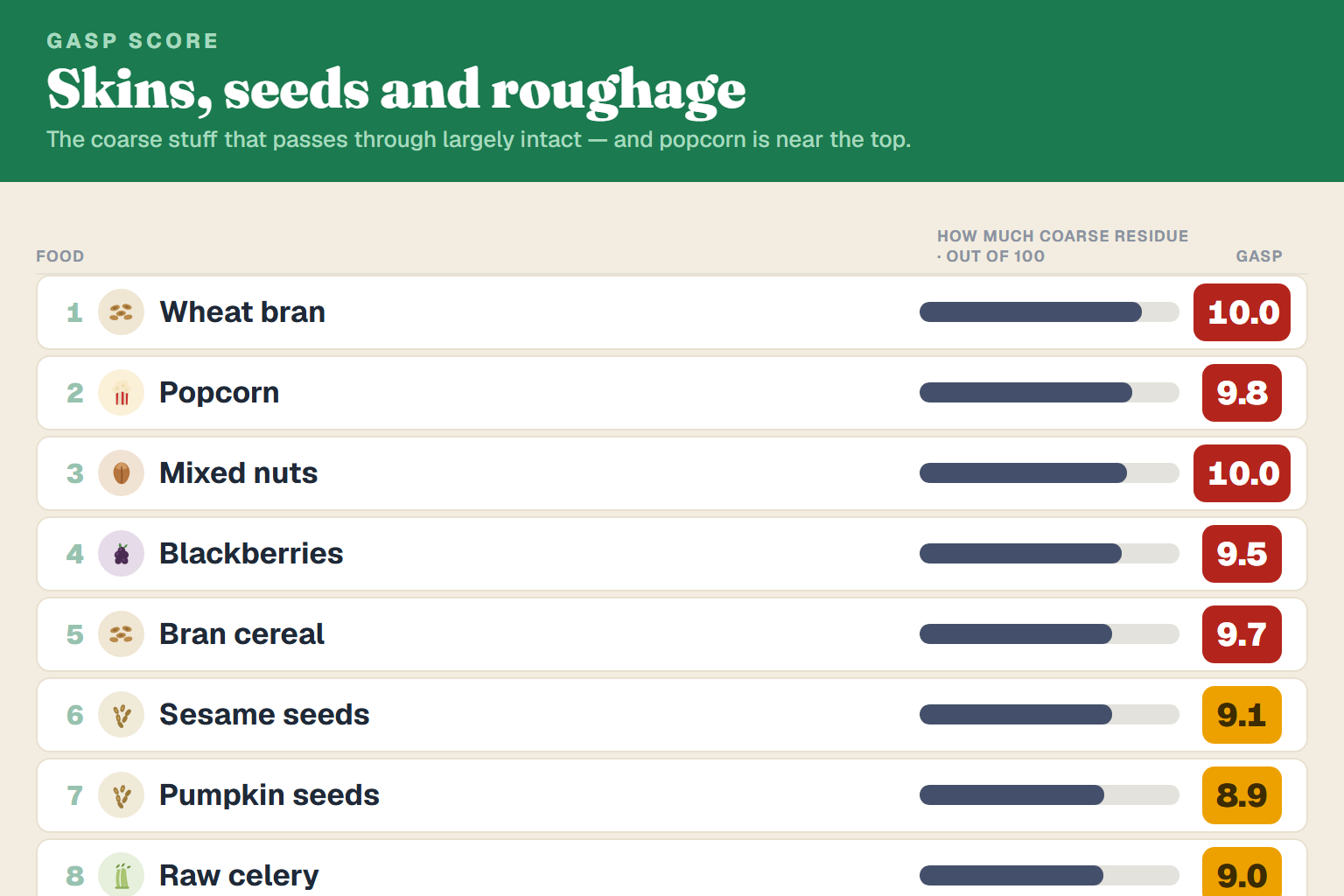
You've probably noticed that some foods seem to arrive at the other end looking much like they did on your plate. Corn is the classic one. Bits of tomato skin, the odd seed, a thread of celery. That's the thing the P in our GASP score is trying to capture: particle load.
What particle load actually means
Particle load is the physical roughage that reaches your pouch largely intact. It's not about gas, and it's not really about how fast a food ferments. It's about texture and structure — the bits your gut can't fully break down.
Think of:
- Skins and peels — apple, capsicum, tomato, potato
- Seeds and pips — strawberry, kiwifruit, passionfruit, tomato
- Pith and membrane — the white part of an orange, the segment walls of citrus
- Stringy or tough fibre — celery, raw rocket, the kernels of corn
- Raw, crunchy textures generally — a big plate of raw salad
These carry insoluble fibre, the kind that holds its shape rather than turning to gel. Useful fibre. It just doesn't soften much on the way through.
Why it can feel rough in a J-pouch
When roughage arrives mostly whole, two things can happen. It can make output scratchier and more uncomfortable to pass. And in larger amounts, especially with foods like corn or coleslaw, it can give you that tight, blockage-type sensation where things feel like they're not moving smoothly.
This matters most early after surgery, when the join is still healing and the pouch is swollen. Many surgical teams suggest a low residue approach for the first several weeks for exactly this reason — less roughage, less to snag on.
The evidence for going gentler early on is reasonably strong. It's standard post-op advice, not a fad.
Gentler ways to handle high-particle foods
Here's the good news: you can often keep a food and just change its form. The fibre is still there nutritionally; you're mostly removing or softening the structure that causes the trouble.
| Move | What it does | Example |
|---|---|---|
| Peel | Removes the toughest layer | Apple, capsicum, potato, sweet potato |
| Deseed | Takes out hard pips | Tomato, cucumber, courgette |
| Cook until soft | Breaks down structure | Carrots, beans, leafy greens |
| Mash or blend | Does the breaking-down for you | Soups, smoothies, mashed sweet potato |
| Chew well | Your first line of defence | Honestly, all of it |
That last one sounds too simple to count, but chewing properly does a real share of the work your pouch otherwise has to do. A smoothie is basically a machine chewing for you.
A blended soup made from the same vegetables that felt scratchy whole can feel completely fine. Same food, different particle load.
This is the axis that relaxes most
If there's one thing worth holding onto, it's this: particle load is usually the part of your range that widens the most as time goes on.
The gut you have three months after surgery is not the gut you'll have at a year. Lots of people start with peeled, cooked, soft everything and slowly find they can manage apple skin, a handful of salad, even corn in small amounts. The pouch settles. It adapts.
So a high P score isn't a closed door. It's more a note that says this one might be easier in a softer form for now.
Trying something back
When you want to test a higher-particle food again, go slow and go alone. One new thing at a time, a small portion, and not three new foods crammed into the same dinner — because if something doesn't sit well, you'll want to know which one it was.
Start with the gentler version. Peeled before whole. Cooked before raw. A few corn kernels before a whole cob. If that goes well, nudge it up next time.
Everyone's gut is different, and our P scores are modelled estimates, not a verdict on your particular pouch. They're a starting point for your own careful experiments. You can browse food scores to see how different foods land, or read how the scores work if you want the full picture.